
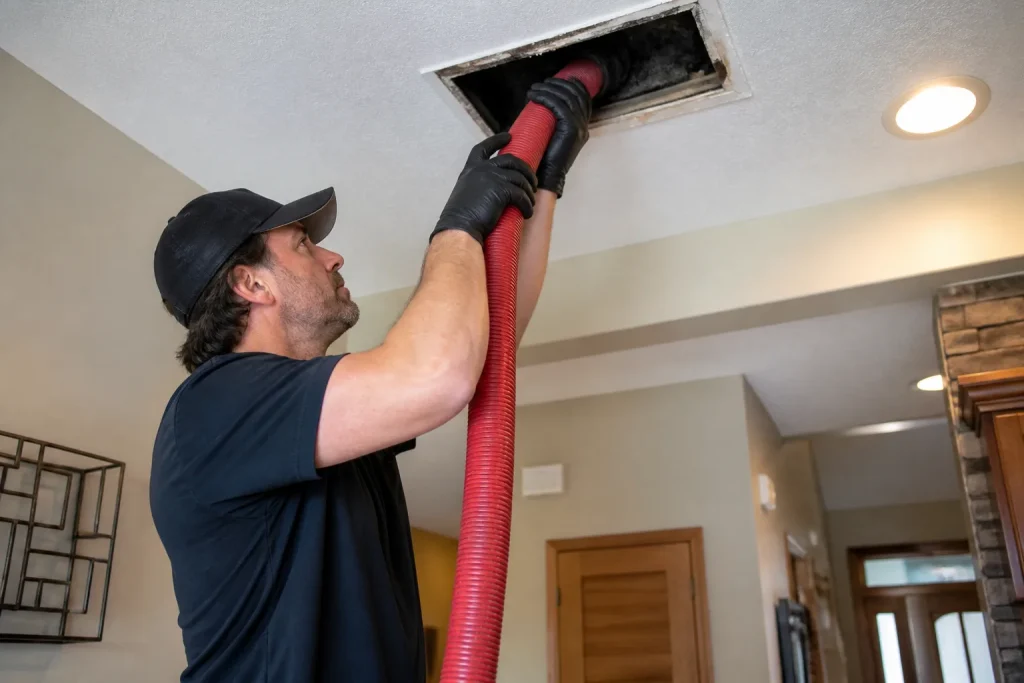
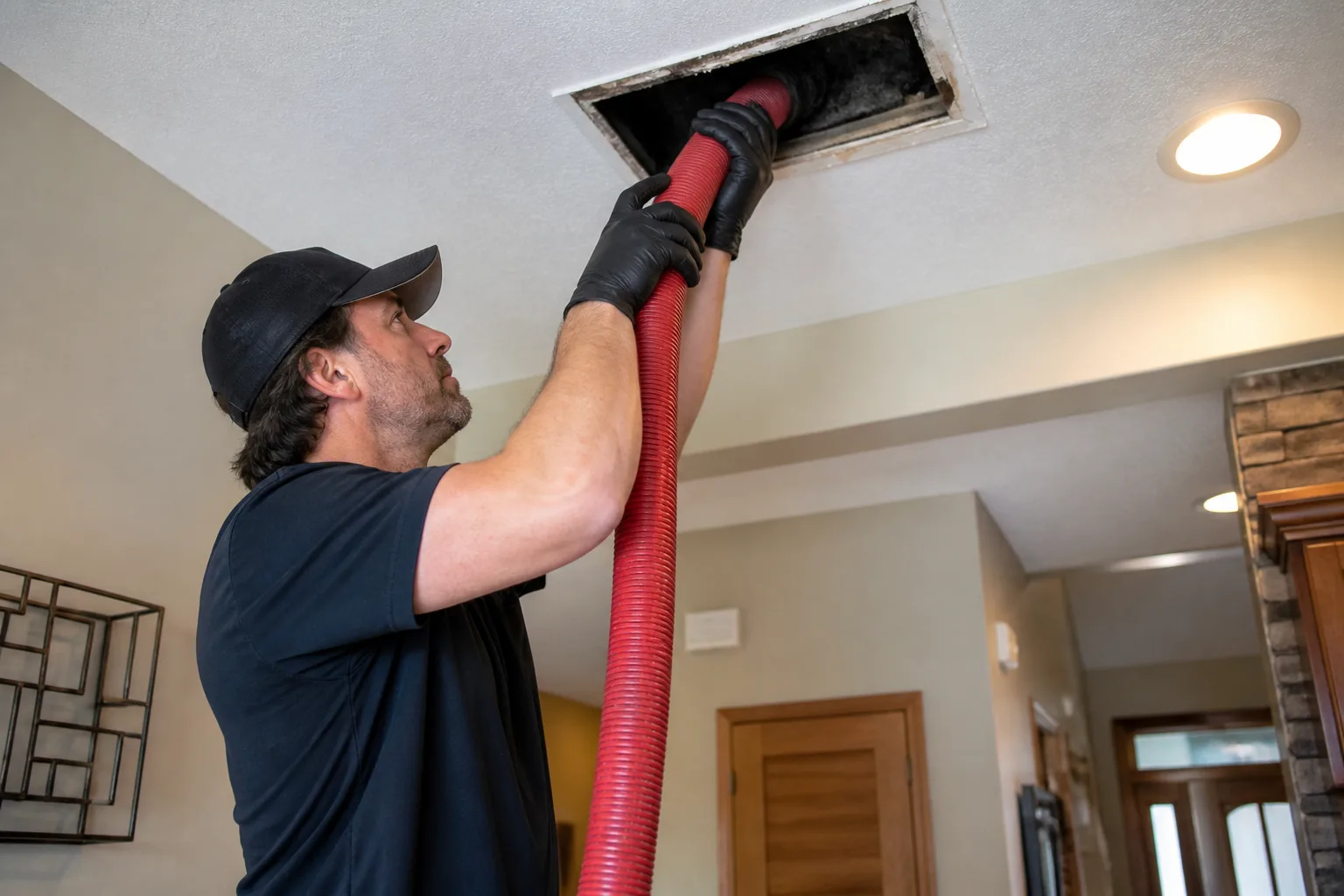
Guardsman Air Duct Cleaning in Spokane: A Homeowner’s Guide
If your Spokane home warranty scheduled a Guardsman air duct cleaning, that’s not the same as independently hiring a duct cleaning specialist. The scope, the equipment standards, and what actually gets inspected can differ a lot depending on which contractor shows up to fulfill that work order. Plenty of Spokane homeowners assume a warranty dispatch means the same thing as a dedicated job – and only find out afterward that the main trunk line wasn’t touched or that the “cleaning” was a shop-vac pass over a handful of registers. This guide walks through what a Guardsman service agreement typically covers, how to tell professional equipment from bargain-tier tools, and how to verify the work actually happened.
What does Guardsman air duct cleaning actually cover in Spokane?
A Guardsman air duct cleaning arranged through a home warranty or new-build service agreement usually covers a basic cleaning of the accessible branch ductwork serving the registers, performed by a contractor assigned to fulfill the work order. It typically does not include a defined equipment standard, a full main trunk line cleaning, or repair of damaged ductwork found during the visit. The scope is set by the work order, not by an assessment of your system.
Here’s the distinction that matters most. When you hire a duct cleaning company directly, you and the company agree on what gets cleaned – how many systems, which trunk lines, how many registers, whether the plenum is included – and you get a written scope before anyone starts. Under a warranty dispatch, that scope is decided elsewhere, often with language like “accessible ductwork” that leaves the heavy interpretation to whoever is holding the vacuum. In our experience working Spokane homes, that gap is where most of the disappointment comes from. Two technicians can both technically “clean ducts” and deliver wildly different results.
What a typical Guardsman dispatch usually includes:
- Cleaning of accessible supply and return branch runs
- Register and grille covers removed and wiped
- Light debris removal from near the register openings
What it commonly leaves out:
- The main trunk line and plenum, where the bulk of settled debris collects
- Any inspection of duct seams, joints, or disconnected runs
- Repair of compromised ductwork – a separate skill from cleaning
- A defined negative-pressure standard or equipment specification
None of that makes a Guardsman dispatch a scam. It’s just a work order with boundaries, and knowing them is what lets you judge the outcome honestly.
How do you verify the technician is using professional-grade equipment?
You verify it by asking before the work begins. Professional duct cleaning relies on negative pressure – a powerful vacuum pulling the whole system under suction while agitation tools knock debris loose inside – so the equipment’s power rating is the single biggest quality signal you’ll get. A standard residential shop vacuum cannot generate meaningful negative pressure across a whole duct system.
Here’s what to look for when the technician arrives at your Spokane home:
- A truck-mounted or high-powered portable negative pressure unit connected to the system before cleaning starts. If the only equipment is a handheld vacuum, that’s a red flag.
- Named equipment brands. Guardsman is one brand in the duct cleaning equipment world, but specialist crews also run systems from Rotobrush, Nikro, and Abatement Technologies. Ask what machine is being connected and confirm it’s rated for residential duct cleaning, not general cleanup.
- Agitation tools inside the ducts – rotary brushes, air whips, or compressed-air tools fed through the system, not just a hose waved at the registers.
- Containment setup. Registers should be sealed or covered during the process to keep debris from blowing back into living space.
- Access points. A real cleaning often requires cutting small access holes in the ductwork, then sealing them properly afterward. Ask where those will go. A technician who never opens the system isn’t cleaning it, just the openings.
If a technician can tell you the equipment brand, the negative-pressure setup, and where access points will be cut, you’re speaking to someone who does this daily. If the answer is vague, that tells you something too.
What questions should you ask before the technician starts in Spokane?
Ask three things before any equipment comes off the truck: what exactly will be cleaned, how the main trunk line will be handled, and how debris will be contained. A technician with real experience answers these without hesitation, and those three answers tell you whether the work order covers your system or just skims it.
A practical pre-job checklist for Spokane homeowners:
- “Will the main trunk line be cleaned, or only the branch runs?” The trunk line feeds every register in the house. If it’s excluded, you’re paying for partial work.
- “Where will you cut access points, and how will you reseal them?” Every access hole should be sealed and made airtight after cleaning. Ask how.
- “How are you handling containment?” Registers covered, plastic sheeting down if needed, and negative pressure maintained throughout.
- “Will you look at the ductwork condition while you’re in there?” Cleaning without inspection misses disconnected joints, crushed flex runs, and torn insulation – all common in Spokane homes with older forced-air systems.
- “What’s the scope in writing?” Get the register count, the trunk line coverage, and the equipment described in writing before the job starts.
These aren’t gotcha questions. Any technician worth having in your home will appreciate that you asked, because it signals you’ll recognize good work when you see it. Our technicians have up to 13 years of experience, and we can tell you the answers come easier the more jobs you’ve run.
What should you inspect after the Guardsman cleaning is done?
Run a post-job check within an hour of the technician leaving. You don’t need technical training – a flashlight, a look inside a few registers, and a walk through the system will tell you most of what you need to know. If something’s wrong, it’s far easier to address the same day than a week later.
Your post-job checklist:
- Look inside several registers with a flashlight. You should see visibly cleaner duct interior. Residue is normal; caked debris and dust webs are not.
- Check for debris on floors, sills, and furniture near registers. Good containment means minimal dust outside the ducts.
- Look at the access points. Holes should be sealed airtight, flush with the duct surface, and not left taped with painter’s tape.
- Run the system and check airflow at several registers. Weak flow at one register after cleaning may mean a disconnected run.
- Smell the air in each room. A musty or dusty smell that lingers an hour after the cleaning suggests debris was redistributed rather than removed.
- Take photos of anything questionable and compare against the “before” condition if the technician documented it.
We can’t overstate how much before-and-after photos help here. A company that photographs its own work isn’t hiding anything, and you have a record if a warranty company asks for documentation later.
When is Guardsman a reasonable starting point, and when do you need a specialist?
A Guardsman dispatch is a reasonable starting point if your ducts are lightly soiled, your system is running fine, and you just want a baseline cleaning under warranty. It’s the wrong tool when your system shows signs of serious buildup, damaged ductwork, or moisture problems – because those need a specialist assessment, and cleaning alone won’t fix them.
Consider independent specialist service instead of (or after) a Guardsman cleaning if you’re seeing:
- Visible debris or dark buildup around register openings
- Weak airflow in one or more rooms that hasn’t resolved after cleaning
- Duct runs that are crushed, torn, disconnected, or visibly sagging – repair, not cleaning, is the fix
- Recent renovation or construction dust that got pulled into the system
- Persistent musty odors with the system running
- A system where the main trunk line was explicitly excluded from the warranty scope
This is where a dedicated specialist earns their keep. Generalist HVAC companies treat duct cleaning as an add-on, but a company whose entire discipline is ducts and dryer vents – running Rotobrush and Nikro equipment and carrying Abatement Technologies gear for higher-demand air quality scenarios – cleans to a standard set by the equipment, not the schedule. We also offer air duct repair as a distinct service, because cleaning a system with a disconnected run just moves dirt around a broken loop.
If you’d rather skip the DIY diagnosis and get an expert read on your system, call (866) 963-7098 for a free estimate. We answer 24/7, with fast dispatch from 7am to 7pm, Sunday through Friday.
How does Guardsman work with professional filtration brands like Honeywell and Aprilaire?
It doesn’t, in the sense that matters here. Guardsman is a name you’ll encounter in warranty and service-agreement contexts, while Honeywell and Aprilaire are air quality and filtration brands installed in many Spokane homes. The two don’t connect – but understanding your filtration setup does affect what a duct cleaning should accomplish.
When a home has a Honeywell or Aprilaire filtration system in the return air path, a cleaning that ignores that equipment misses an important part of the system. Filter housings, media cabinets, and bypass setups collect debris and can be a source of odors if left untouched during a routine clean. A technician who works with these brands regularly knows how they’re assembled, what to check, and what to leave alone. That’s a different skill from vacuuming registers.
For homeowners who want the fuller picture, our air duct cleaning page explains how professional cleaning is scoped by system, and our home page at Duct Cleaning Spokane lays out the full service menu – air duct cleaning, dryer vent cleaning, and air duct repair. Three services, done properly, every job a core job rather than a side offering.
The Bottom Line
A Guardsman air duct cleaning arranged through a warranty is a legitimate starting point, not a full specialist service – and knowing the difference is what protects you from paying for a cleaning that missed the parts of your system that actually matter. Ask what’s covered before the technician starts, verify the equipment is professional-grade negative pressure, and inspect the work before you call the job done. If your ducts need more than the warranty scope provides, that’s when a dedicated specialist is the right call, whether you’re in Spokane, out toward the South Hill, up on the North Side, or anywhere else in the area.
If you’re in Spokane and need help evaluating what your ducts actually need, Duct Cleaning Spokane offers free estimates – call (866) 963-7098. We answer 24/7. Fast dispatch from 7am to 7pm, Sunday through Friday. One flat price per system agreed before work starts, before-and-after photos of your own ducts, and a written estimate that sets the final price.
Frequently Asked Questions
No. A Guardsman cleaning arranged through a warranty or service agreement is a work order with a defined scope, usually covering accessible branch ductwork, performed by an assigned contractor. A specialist you hire directly sets scope by your system’s condition, uses professional-grade negative pressure equipment, and inspects for damage while cleaning. Call (866) 963-7098 for a free estimate if you’re unsure which your ducts need.
Check inside several registers with a flashlight, look for airtight seals on any access holes, confirm no dust was left on floors or sills, and run the system to verify airflow is even at each register. If a company can’t provide before-and-after photos of your ducts, that’s a signal the work wasn’t documented. Call (866) 963-7098 if you want a second opinion – estimates are free.
Usually not. Air duct repair is a separate scope from cleaning, and most warranty dispatch work orders don’t include it. If a technician finds crushed, torn, or disconnected ductwork, that’s typically a separate conversation. We handle cleaning and repair on the same ticket so you’re not calling a second contractor – call (866) 963-7098 for a free estimate.
Most homes benefit from cleaning every few years, more often after renovation or if anyone in the house has respiratory sensitivities. A warranty dispatch can serve as one of those cleanings, but it doesn’t replace an assessment of your system’s actual condition. When it’s time for a proper clean, call (866) 963-7098 – estimates are free.
Cheap quotes usually mean cheaper equipment and a narrower scope – often just the register openings and branch runs, cleaned with tools that don’t generate real negative pressure. The industry’s bait-and-switch reputation exists for a reason. We work on one flat price per system, agreed before work starts, with before-and-after photos of your ducts. Call (866) 963-7098 for a free written estimate.
Written by the team at Duct Cleaning Spokane.
Need Air Duct Cleaning Help?
Call Duct Cleaning Spokane - licensed & insured, with free written estimates in Spokane.
(866) 963-7098